





Why have Springbok-littered South African sides failed to make a mark on Europe’s premier club competition?

South Africa still remains a little distance from Europe. Don’t panic, neither Europe or South Africa have shifted off the continental crust and moved towards each other.
If either had, Donald Trump would probably have laid claim to both and then looked to rename them North and South Trumpica.
The reference to South Africa still being a little distance from Europe is a reference to the South African teams having not managed to crack European competition, namely the European Rugby Champions Cup.
That isn’t the case in the Challenge Cup of course, where the Sharks have already been victorious (in 2023-24). However, when most South African supporters aimed their gaze away from Super Rugby towards Europe, the Champions Cup was the goal.
What is the issue with South African teams in the Champions Cup?
The lack of meaningful penetration into European competition has come as a bit of a surprise to the writer of this column, whose fascination with South African rugby has led to him becoming at least 37% South African over the past few seasons and seen him drink Brandy and Coke in volumes not witnessed in the UK since the late ’80s.
When the South African teams joined the Champions Cup in the 2022-23 season, it seemed reasonable that one/two of their teams would be semifinal/final contenders within the first three or four years.
That hasn’t quite transpired so far. Not to the same degree that it has in the United Rugby Championship, for example, where their presence has been felt since minute one.
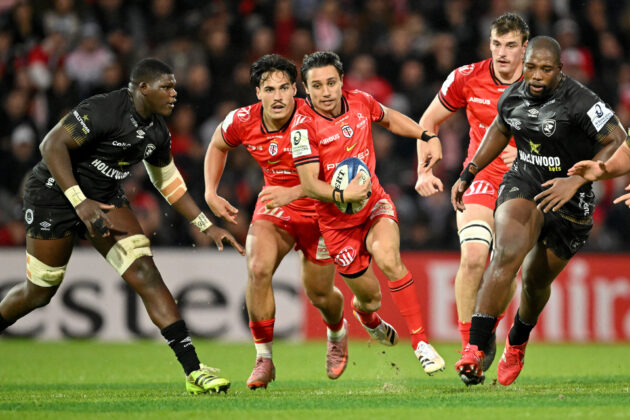
Ange Capuozzo and Toulouse gave the Sharks a torrid afternoon in their European Rugby Champions Cup opener (Lionel Hahn/Getty Images)
In the opening weekend of this season’s Champions Cup, the Stormers were the only one of the three South African sides in the competition to come away with a victory. Last season, none of the three South African teams involved in the pool stages (the Bulls, the Sharks and the Stormers) made the knockouts, winning just three fixtures of the 12 they played in total. The Bulls later went on to reach the quarter-finals of the Challenge Cup.
While it has come as a surprise that the South African teams haven’t been able to adjust to the competition in the first few years, there are some valid reasons as to why.
Why are the South African teams struggling in the Champions Cup?
Firstly, the Champions Cup is no doddle. Look at Leinster for example. A team dedicated to and set up for European competition hasn’t been able to defeat the end boss for many a season.
They’ve made four out of the last seven finals but failed to raise the trophy – even when they have razed virtually every team to the ground during the regular season. When a team such as Leinster finds it hard to lift the silverware, maybe we need to address the parameters with which we’re judging South Africa’s lack of success in the Champions Cup.

The Springboks have remained dominant in 2025, winning the Rugby Championship and taking a northern hemisphere clean sweep in the Autumn Internationals (Charles McQuillan/Getty Images)
Another major problem is squad depth and cash. Wages in Europe and Japan are still hugely attractive to South African players – and who can blame them?
So, while being able to play overseas doesn’t affect the Springboks, it does still affect their provincial system. In the most recent Bok alignment camp for example, 20-ish of the players from a total of 76-ish were based overseas.
That’s nearly an entire squad of players who could feature for one of the four South African provinces. If the South African teams had all of their players back home, it would be a very different story for both South African and European teams.
The South African teams would not only become stronger, but at the same time make their European competition weaker – it would be like a scene from Cocoon (a mid-’80s movie reference for the older readers).
We must also remember, of course, that the South African provinces don’t have the luxury of signing masses of overseas players. If they have weak spots in their squads, they can’t simply bring in a stack of Pacific Island problem solvers as French sides do in the Top 14.

The Sharks departed the Champions Cup at the pool stage last season (David Rogers/Getty Images)
The structure of the South African season also doesn’t help their provincial level game. South African rugby is playing a hybrid season, in that their provinces are following the northern hemisphere calendar, but the Boks are still following the southern hemisphere schedule.
It means that player release at provincial level can be a difficult balance. This is a particularly difficult issue to solve when player welfare is such an important concern in the modern game.
The South African provincial teams could arguably select better squads for European competition, but it would come at a significant cost to their players’ mental and physical wellbeing.
Should we expect more from the South African teams?
Then there’s the argument that maybe, as a rugby public in Europe and in South Africa, we’re expecting too much from the South African teams.
They were, of course, strong contenders when they played in Super Rugby and had great success, but it’s not as if they dominated the tournament every year – far from it.
Much of the above has led to criticism of the South African teams for possibly not selecting their strongest teams in Europe – especially when playing away. But when Saracens do it, as they did in last season’s round-of-16 match defeat to Toulon, the shouting is rather more muted.

The South African sides still seem some way from challenging last season’s champions Bordeaux Bègles, who beat the Bulls on the Champions Cup’s opening weekend (Michael Steele/Getty Images)
But while there are certainly factors that can excuse/explain the South African teams having a slow start in European competition, there are also some inescapable truths. The Sharks being a great example.
A team with a budget meatier than a boerewors stuffed with droëwors, then rammed full of biltong should be able to sustain a challenge in both the URC and European competition, yet they’re currently languishing in 14th place in the URC, having won just a single game (against the Scarlets). They also suffered a comprehensive defeat to Toulouse in their opening game of this season’s Champions Cup.
You could argue that the Sharks’ desire to have a Bok in virtually every position is detrimental to squad cohesion and player availability. On occasions it seems as though building a brand has overtaken the need to build a team.
- Related: The best South Africa rugby jerseys
However, let’s not worry too much about South African rugby. As a pro rugby ‘funnel’ their structure in functioning perfectly – with Test rugby performances paying the bills.
With the increased revenue from European rugby and the ability to bring back more and more of their quality players (the Bulls’ Handré Pollard being a fine example), the next few seasons should hopefully see South African provincial rugby make as big a mark on Europe as it does at Test level – at Test level they’ve left a literal and metaphorical mark on virtually everybody.