




Isgró is a former World Rugby Sevens Player of the Year and was part of the Los Pumas team to beat the British & Irish Lions this summer
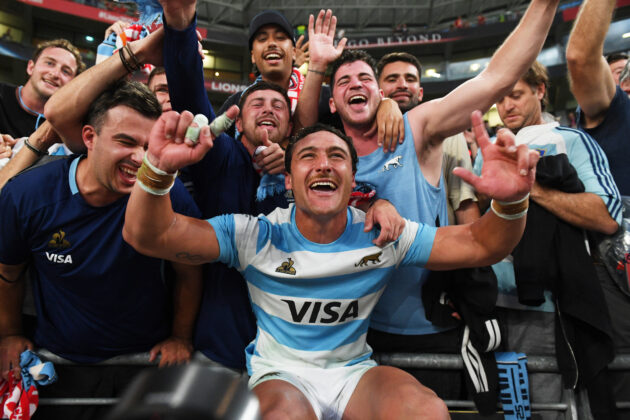
Harlequins’ Marcus Smith is rarely seen without his mate (mah-teh) thermos, sipping the bold, earthy South American drink that’s become a ritual. He owes his love for mate to former Argentine teammates and now shares it with Rodrigo Isgró, the dynamic Puma winger who joined last season.
For Isgró, mate is more than a caffeine boost – it’s a bond to his Mendoza roots and a bridge to team camaraderie. “Yes, I introduced him to mate,” says Martín Landajo, the former Quins and Puma scrum-half, proud to open a new door for Smith. “He slowly embraced it and it’s now part of his daily routine.”
Related: How to watch the Autumn Internationals
Mate is a part of Argentine traditions and drinking it with friends is a constant bonding experience. This season, Smith will have a larger group of team-mates to share it with. Landajo and Santiago García Botta may have left, but the mate-drinking club will include new Quins Pedro Delgado, Boris Wenger and Guido Petti, alongside Isgró.
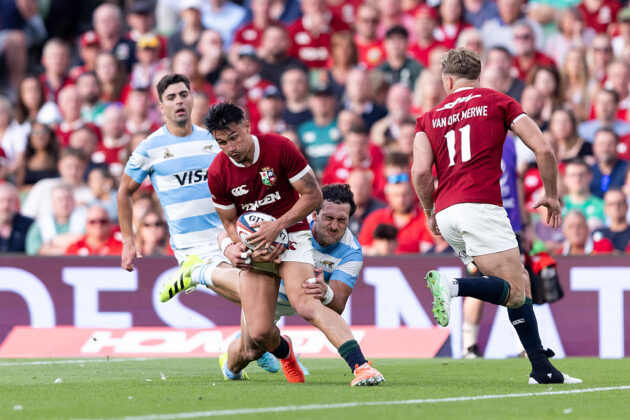
Marcus Smith is tackled by Rodrigo Isgró (Getty Images)
As tradition states, you sit around the mate and share it, sipping it from the same cane. Smith, and mate, were important to Isgró when he joined the club. “I moved to Guildford, where most of the guys live, including Marcus,” says the burly wing. “He was very accommodating, driving me to training initially and sharing mate with me, slowly getting me into the social side of the team, making me feel part of the team culture. He was of great help.”
When Isgró arrived in London, he had to get reacquainted with the game in its XVs form. This is why. Born and bred in the Mendoza, under the cold stare of the Andes, the land of good Malbec and Federico Méndez, Isgró embraced the game from an early age thanks to a former rugby-playing uncle. Soon, his parents got involved too and father Eugenio became the team’s admin manager, a role he continues to fulfil at Mendoza Rugby Club with the passion that characterises his son.
Related:10 things you should know about Smith
“I played many sports growing up but it was always rugby that I would gravitate towards,” he tells RW ahead of his return to London after playing for Argentina in the Rugby Championship. “And from U15s I took it more seriously. We had Federico (Méndez, the ex-Bath and Northampton dual European champion) and Lali Viazzo as coaches and started with adequate nutrition, gym work and skills.”
Rodrigo Isgró: Sevens star with X-factor
Isgró always stood out and his future was positive, playing at fly-half (where he played senior rugby for the Mendoza club) and centre. Even though a torn ACL cost him almost a season in 2018, and his first Junior World Championship, he bounced back and played for Argentina U20 in a championship at home in Rosario.
There, he played with future Pumas Mateo Carreras, Saracens duo Juan Martín González and Lucio Cinti, Gonzalo García and Santiago Chocobares, starring for the national team. Soon after, “as I was terrified of the prospect of playing overseas, Santiago Gómez Cora (the Pumas sevens coach) called me as he wanted me to try out for the team”.
Gómez Cora picks it up. “We are constantly looking at players with X-factors and I had seen Rodri in a Pumitas warm-up game against Jaguares that year; he jumped high in the sky and won a couple of balls and I took note of that.”
Little did they know that the road that Isgró took in September 2019 would lead to two Olympic Games and a World Rugby Sevens Player of the Year Award. “My first trip overseas was to London where we played in Rugby X at the O2 Arena; an incredible experience, the venue, the city, everything,” smiles Isgró, his mind wandering to that first trip to the city he now calls home.
Related: All you need to know about Hong Kong Sevens
His sevens debut was delayed due to a hamstring tear, but finally he played in Hamilton and Sydney, his first two HSBC Sevens Series tournaments, adding two more (Los Angeles and Vancouver) before the world stood still for a few months. Covid-19 hit hard and Argentina had one of the worst social closures in the world.
As a pro sportsman, Isgró says that the postponement of the Tokyo 2020 Olympics worked in his favour. “Had it not been for the pandemic, I might not have made the team for the Olympics as I was only starting and it takes time to adjust. That it was held a year later allowed me to work harder in the game, get more tournaments under my belt and prepare better,” he explains.
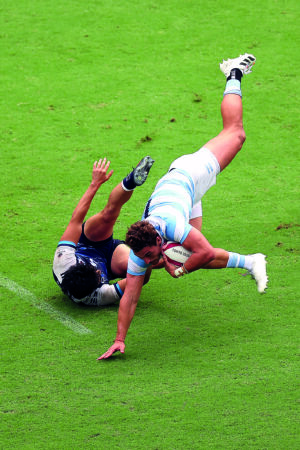
Rodrigo Isgro of Team Argentina is tackled by Seongbae Lee of Team South Korea during the Men’s Pool A Rugby Sevens match between Argentina and South Korea on day four of the Tokyo 2020 Olympic Games (Getty Images)
Argentina reached Tokyo with a team full of talent and raw power, a category in which Isgró is always included. The quarter-final against South Africa was the turning point for a team that had come close to a semi-final in Rio five years earlier. That warm night at Deodoro, in the outskirts of Brazil’s most famous city, the quarter-final against Great Britain went to sudden death when Gastón Revol missed a sitter of a penalty in the final seconds of regular time. GB flew home with the silver medal.
In Tokyo, at the same stage, the now legendary Revol was sent off against South Africa. Yet with only five players on the field, they managed to control the Blitzbokke and earn their place in a medal game. GB were beaten 17-12 and Los Pumas’ Sevens won the bronze. “That red card brought us together and gave us all that we had,” Isgró says. “I gave the medal to my family as it is theirs. It is the most important thing that I’ve won and as an object it signifies all the work done in my life.”
Related: Sevens at the Olympics
With three years to go until the next Olympic Games in Paris, the momentum saw most of the squad stay in sevens and Argentina went on to conquer the shortened game, becoming the team to beat and winning the world series in 2024, the year that all expected to again win an Olympic medal. “After Tokyo, we started the process towards Paris and I was super-focused. By then I had a different place in the team.
“Sevens was the best thing that happened in my life: great friends, travel the world, good and bad moments, but all was very, very special. I am who I am as a person and player partly thanks to sevens and Santi (Gómez Cora).” The 2023 season was his best, playing all 66 games his team played.
Pumas debut and first World Cup
When the season finished, he was told that then head coach Michael Cheika wanted to meet him. He duly made his Test debut against the Wallabies and his first Rugby World Cup in France followed with a try-scoring debut against Chile in Nantes. “We agreed that after that I would fulfil my commitment to sevens.”
He did and Argentina had another stellar campaign heading into Paris 2024. Whilst Isgró was again a star, things derailed in the final series game as he was sent off and suspended for five games. In Paris, having sat out his ban, he was only able to play the final three games, including the quarter-final loss against the home side, with almost 80,000 spectators jeering Los Pumas Sevens – the French still can’t accept Messi and Co beating them in Qatar 2022!
“The Olympic Games were hard; I learnt a lot, yet I don’t have sweet memories. It is still a thorn that hurts, but I’m a believer that life sometimes gives and sometimes takes. It wasn’t to be and I will forever love my time in sevens.” Isgró became a Harlequin shortly after the Games, after playing in his second Rugby Championship.
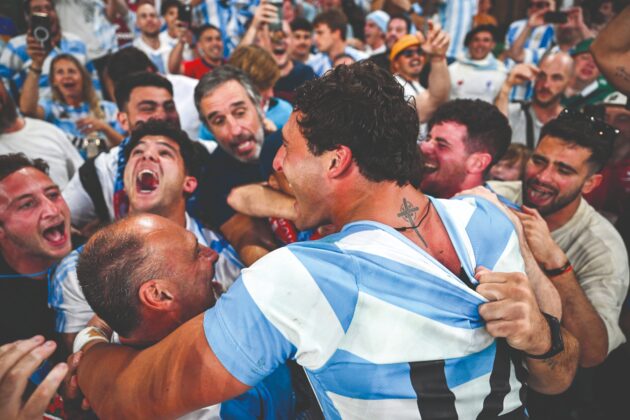
Rodrigo Isgro of Argentina celebrates with supporters (Getty Images)
He became the eighth Argentine to don the multicoloured shirt in the pro era after Pablo Cardinali, Tomás Vallejos, Pablo Bouza, Gonzalo Tiesi, Gonzalo Camacho, García Botta and Landajo. “Argentine players bring firepower as part of our culture, of our DNA,” says winger Camacho, who scored the winning try in the 2011 Challenge Cup final against Stade Français.
Related: Harlequins novelty song
“They see in us a resilience against frustration, that we work hard, always want to play, give no excuses. Given the country we come from and the many challenges, we are creative in reinventing ourselves.” Quins contacted Landajo, who shared the No 9 jersey with Danny Care, before reaching for Isgró and Isgró then contacted him to find out what to expect.
“I gave them the best references about Rodri and I told him this was a club that looks after the player.
“I was very well looked after and they prioritise the players, offering them a lot of opportunities outside of the game. I agree with Gonzalo in that as Argentines, with our way, we fit perfectly at the club.” Isgró was an instant hit, scoring twice on debut against Bath in October 2024 and crossing again a week later against Exeter.
Within a few months, the winger signed a contract extension that will see him at The Stoop for three more years. Former head coach Danny Wilson praised his athleticism, describing him as a physical specimen who knows his way to the try-line. He added: “Rodrigo’s ability in the air is also fantastic, which adds another dimension to our kicking game.”
His smiling demeanour and open friendliness has made Isgró a fan favourite. As he leads into his second season, he finishes: “The Quins fans are great; extremely knowledgeable and friendly. “It’s a very nice, close relationship we have. The players, the staff, the whole club have made my time here very good. I couldn’t have chosen a better place.”
Download the digital edition of Rugby World straight to your tablet or subscribe to the print edition to get the magazine delivered to your door.